 Moonwell
 mToken redemption depends on available liquidity and collateral requirements
Moonwell mTokens represent supplied crypto and accrued interest, while redemption depends on available market liquidity and collateral requirements for active loans. A withdrawal exchanges the corresponding mTokens for the supplied asset. There's no lockup, but limited liquidity or collateral backing debt can restrict the amount available to redeem.
A smaller withdrawal can release part of a supplied position when it fits available liquidity and preserves required loan collateral.
Withdrawal Size Against Available Liquidity
A requested withdrawal must fit the unborrowed liquidity in its own market, even when the supplied position is larger. The supplied balance represents the position's underlying asset value, including interest. Available liquidity describes the tokens the pool can return now. Borrowers may already be using part of that pool, so the amount represented by a large supplied position can exceed the liquid assets the market can return when you request a withdrawal.
Liquidity belongs to the selected market. An asset balance elsewhere in the protocol doesn't refill that pool.
At 100% utilization, a market has no supplied assets immediately available for withdrawal. A partial shortage can also prevent a larger request, even before borrowers have used every available token. Comparing the requested underlying amount with available liquidity addresses both situations.
Borrower repayments and new supplies of the same asset can replenish liquidity. Further borrowing can reduce it again before a withdrawal executes.
The Position Represented by an mToken
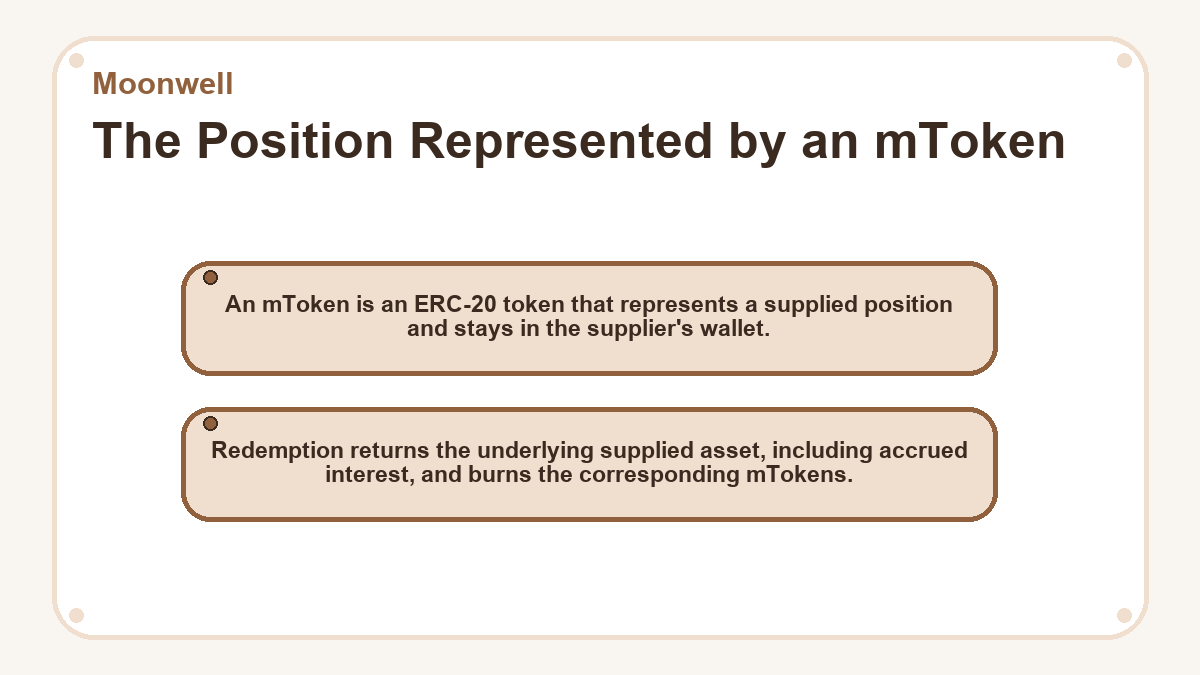
An mToken is an ERC-20 token that represents a supplied position and stays in the supplier's wallet. Redemption returns the underlying supplied asset, including accrued interest, and burns the corresponding mTokens.
Accrued Interest in the Withdrawal Balance
Accrued lending interest forms part of the amount returned when a supplied position is redeemed successfully. It doesn't require a separate interest claim.
Automatic Compounding
Interest accrues each block and compounds into the supplied position. Future interest therefore builds on a larger amount without a manual reinvestment step. A full withdrawal includes the interest earned up to withdrawal, subject to liquidity and collateral limits.
Changing Annual Estimates
The base annual percentage yield (APY) estimates the annualized return from lending interest, which varies with market utilization. Total supply APY can also include incentive rewards that accrue separately and require manual claiming. It doesn't lock in the future return. The period supplied and the rates over that period affect accumulated interest, so the displayed APY alone can't establish the exact final withdrawal balance. A position can keep accruing interest while withdrawal availability remains limited.
A Partial Redemption With Limited Liquidity
A full withdrawal exceeds available liquidity in this hypothetical case: a USDC position, including interest, is worth 263 USDC. Assume its Core Market has 183 USDC available, and the supplier has no outstanding loan. The intended withdrawal is the entire supplied balance.
The Request for the Full Balance
The mUSDC position represents the supplied USDC, but the intended withdrawal exceeds available liquidity by 80 USDC. A request for all 263 USDC therefore can't complete under these assumptions. The limiting condition is the pool's available USDC; no active debt requires this supplier to retain collateral.
The Smaller Redemption
If a 183 USDC withdrawal succeeds before the assumed balances change, it leaves 80 USDC supplied. The transaction burns the mUSDC corresponding to the redeemed amount and returns 183 USDC to the wallet. These figures measure underlying USDC value. The remaining position continues to accrue interest, while its later redemption still depends on available liquidity.
Collateral Reserved for an Active Loan
An active loan can restrict redemption even when the selected market holds enough liquid assets for the requested withdrawal.
The Amount Above the Requirement
A borrower must retain enough eligible collateral to support outstanding debt. A withdrawal that would leave an active loan below its collateral requirement fails. Some supplied value may therefore need to remain in place, despite sufficient liquidity in the underlying pool. A partial withdrawal can be possible without repaying the entire loan, provided the remaining collateral satisfies its requirement.
Debt Reduction or Additional Collateral
Repaying part of the debt reduces the collateral needed to support it. Supplying additional assets can also free part of an existing position for withdrawal, provided the new supply is eligible collateral under the relevant market's parameters and you enable it for that loan. These changes address the loan requirement; they don't ensure that the market for the asset being redeemed has enough unborrowed liquidity.
The Max control requests the entire supplied position. It doesn't override the collateral requirement or the market's liquidity limit.
The Market and Network Behind the Position
The relevant withdrawal information belongs to the market and network that hold the supplied position, since available assets vary across networks and each listed asset has its own market conditions. A liquidity figure from another market doesn't establish how much this position can redeem, even when the asset names look similar. The underlying asset, its corresponding mToken, and the market's available liquidity need to describe the same supply position.
Network selection also determines the context for collateral parameters, interest rates, and available liquidity, so the conditions shown in one market can't establish withdrawal availability for a supplied position held on another network.
Protocol Fees and Network Gas
Moonwell charges no protocol fee to withdraw supplied assets. Network gas still applies to the transaction. Gas pays for network execution; it doesn't increase the pool's liquid assets or relax a collateral requirement.
For a small redemption, gas can represent a larger share of the value moved. A smaller request may fit the market's liquidity and collateral limits, though its transaction cost remains relevant. Waiting for a larger withdrawal changes the timing question, without establishing when sufficient liquidity will return.
When Do Redeemed Assets Reach the Wallet?
Redeemed assets reach the wallet after the withdrawal transaction successfully confirms onchain, provided liquidity and collateral conditions allow the redemption. Confirming a request in the wallet authorizes the transaction. The onchain outcome establishes whether it completed successfully and returned the underlying asset, with the corresponding mTokens burned.
A liquidity shortage creates a separate waiting period before the requested withdrawal can succeed. That delay depends on market changes, such as borrower repayments or new supply. The time needed for enough liquidity to return doesn't follow from the blockchain's confirmation time. There's no fixed lockup to count down.
Remaining Exposure While Assets Stay Supplied
An unredeemed position remains exposed to the lending contract and, where relevant, the loan that it supports. A liquidity restriction by itself doesn't establish that liquidation occurred. Liquidation concerns insufficient collateral for an active borrow. Supplying without borrowing doesn't expose that supply to borrower liquidation, even if the market temporarily lacks enough unborrowed assets for a full redemption.
Smart contract risk also remains while assets stay supplied. A successful partial withdrawal releases only the portion redeemed; it doesn't remove exposure associated with the remaining position. Market liquidity, the supplied asset's value, and outstanding debt can continue to change while that remainder stays in the protocol.
Worth knowing
Can I Withdraw One Supplied Asset While Leaving Another in Place?
Separate assets have independently managed supply positions, so redeeming one doesn't require withdrawing every other asset. If an active loan relies on that supply, the remaining eligible collateral must still cover the loan. The available liquidity that matters is the pool for the asset being redeemed.
How Does Claiming Core Market Incentives Differ From Redeeming mTokens?
Claiming Core Market incentives collects additional rewards through a separate rewards control. Redeeming mTokens returns the supplied asset and its accrued lending interest. Interest compounds into the supplied position automatically, while the additional incentives have their own claim process.
Does a market's Borrow Cap Set My mToken Withdrawal Limit?
A borrow cap limits new borrowing, while mToken withdrawals depend on available liquidity and any collateral that must remain for existing debt. Reaching the cap doesn't itself describe how much unborrowed liquidity is in the pool. It also doesn't establish how much of a supplied position secures a loan.
Where Can I Find Liquidity Information for the Asset I Want to Redeem?
The selected asset's market information in the Lend or Borrow view shows its available liquidity. Match the asset and network to the supplied position. The total supplied balance describes the position's value; available liquidity addresses how much underlying asset the pool can currently release.
Could Price Changes Reduce My Withdrawable Collateral After Liquidity Improves?
Yes, collateral price changes can reduce the amount withdrawable against an active loan even when market liquidity improves. Accumulating borrowing interest can also reduce the surplus above the loan's collateral requirement.
Are Vault Shares the Same as Core Market mTokens?
Vault shares and Core Market mTokens represent different lending structures. A Core Market position participates in a shared lending pool. Vault shares represent a proportional interest in assets allocated across isolated markets, so a vault deposit has its own share balance and withdrawal mechanics.
Updated on