 Moonwell
 connects crypto lending and borrowing through markets with variable interest rates
Moonwell lets you earn variable interest on supplied crypto or borrow against eligible assets that secure your loan. Core Markets pool liquidity for direct lending and borrowing, while Vaults allocate deposits across isolated markets. Interest rates move with market conditions, and withdrawals rely on the liquidity available in the relevant market.
Supplying and borrowing create different obligations. A supply-only position avoids loan liquidation, while a borrower must maintain enough collateral as debt accrues. The asset markets available to a wallet also depend on its selected network.
Borrowers can lose available credit as interest accumulates, even when the price of their supplied collateral stays unchanged.
Core Markets and Vault Allocations
Core Markets and Vaults differ in who handles allocation: a direct supplier selects a market, while a vault allocates deposits across isolated markets.
A Selected Core Market
A Core Market brings supplied assets and borrowing demand into a shared pool. Borrowing draws from the pool's available liquidity and requires sufficient eligible collateral. Supplying alone doesn't create a debt obligation.
Allocation Through a Vault
Vaults accept a deposit and allocate assets across isolated markets on the depositor's behalf.
What Do mTokens Represent?
mTokens are ERC-20 receipt tokens that represent supplied positions in Core Markets. The USDC market uses mUSDC receipts. The underlying asset supplies the pool's lending liquidity. Interest accrues to the position over time. A withdrawal redeems the relevant mTokens, which the protocol burns in exchange for the underlying asset and accrued interest. The market still needs enough available liquidity to fulfill the redemption.
Why Do Lending Rates Change?
Lending rates change with market utilization, which reflects how much of a pool's supplied liquidity borrowers have taken. The interest-rate curve defines the relationship between utilization and rates. The displayed annual percentage yield (APY) on a supply position is an estimate at current rates. It doesn't lock in a return for the time that assets stay supplied.
Supply interest accrues and compounds automatically. Interest earned each block joins the supplied position, and later interest accrues on that larger amount. Compounding describes what happens to earned interest; the variable rate determines how quickly it accrues. The mechanism doesn't require a separate reinvestment action.
Borrowing creates interest costs on the outstanding loan. Accruing debt can reduce remaining credit even when the collateral's market value stays unchanged.
Governance can also adjust interest-rate curves. That changes how rates respond to utilization, beyond ordinary movement along an existing curve.
Collateral Choices for Earning and Borrowing
Collateral changes a supplied position's borrowing role: enabling an eligible asset lets its value support a loan.
Supplying Without a Loan
Suppliers who only want interest don't need to enable collateral. If they never borrow, their supplied assets aren't subject to liquidation. Smart contract risk remains, including for a position that has no loan attached. The protocol uses audits, an asset listing framework, and Chainlink oracles as risk controls.
Borrowing Against Eligible Assets
A supplied asset's collateral factor determines how much of its value can support borrowing. The account's remaining credit limits the loan, and the chosen borrowing market needs enough liquidity. Collateral settings belong to the relevant asset market.
A loan's collateral margin can shrink as debt accrues. Price declines or accumulated interest can leave the position below its required collateral threshold, making it eligible for liquidation. Liquidation uses some collateral to repay debt.
Network-Specific Assets and Markets
The assets available to supply or borrow depend on the selected network and the markets listed there. The Markets view shows the assets available for the network connected to the wallet. The asset list and collateral settings answer different questions: the list identifies the available markets, while a collateral factor governs an asset's contribution to borrowing capacity. Selecting an asset market also selects the interest-rate conditions associated with that position.
Transaction Costs on Small Deposits
Small deposits can earn interest, though transaction costs can consume a meaningful part of that return. Moonwell charges no protocol fee for supplying or withdrawing assets in Core Markets. Network gas still applies to each transaction. Gas costs affect the net interest earned from a position.
Borrowing interest is separate from supply and withdrawal charges. A collateral-backed position can earn supply interest and owe borrowing interest at the same time. Those rates describe different sides of the position, so the collateral's supply APY alone doesn't establish the cost of maintaining the loan.
When Can Withdrawals Be Limited?
Withdrawals can be limited by insufficient market liquidity or, for Core Market borrowers, by collateral requirements. A withdrawal fails if it would leave a loan undercollateralized. Repaying debt or adding eligible collateral can free more of the supplied balance for withdrawal. At 100% utilization, all supplied assets in that market are borrowed and none are immediately available for withdrawal. An accrued interest balance remains part of the position even when the pool can't immediately release the corresponding underlying assets.
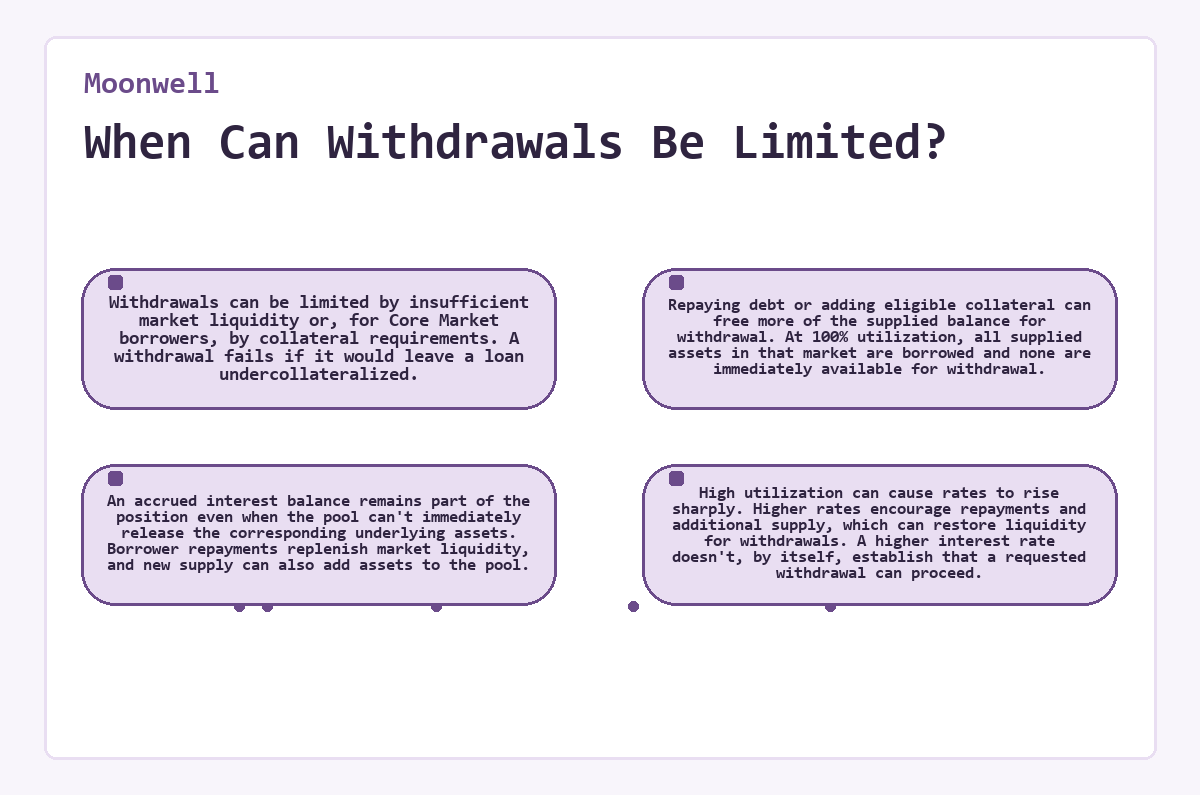
Borrower repayments replenish market liquidity, and new supply can also add assets to the pool. High utilization can cause rates to rise sharply. Higher rates encourage repayments and additional supply, which can restore liquidity for withdrawals. A higher interest rate doesn't, by itself, establish that a requested withdrawal can proceed.
Supply Income and Collateral-Backed Loans
A supply-only position and a collateral-backed loan leave different constraints to manage. The choice between a direct market and a vault separately determines how supplied assets are allocated.
- Choose a Core Market position to select a particular lending pool, or a vault for allocation across isolated markets.
- Keep the position supply-only when earning interest is the task and a loan isn't needed; smart contract risk still applies.
- Before borrowing, account for enabled collateral, collateral factors, remaining credit, available liquidity, and room under the market's borrow cap.
- Allow for variable borrowing interest when assessing how collateral supports an outstanding loan.
- Base withdrawals on your supplied balance, available market liquidity, and any collateral that must remain to support a Core Market loan.
Once borrowing enters the position, available credit must also accommodate ongoing interest and changes in collateral value.
Everyday questions about Moonwell
Can I Supply More Than One Asset at a Time?
You can supply multiple assets at the same time. Each asset has its own interest rate and collateral factor, and you manage each position independently on its market page. A rate or collateral setting for one supplied asset doesn't automatically describe another asset in the same account.
Does a Core Market Require a Minimum Supply Amount?
Core Markets don't set a minimum supply amount. Network gas still applies to the supply transaction, so a permitted small deposit can have a substantial transaction cost relative to its value.
Why doesn't a Supplied Asset Increase My Borrowing Capacity?
A supplied asset contributes no borrowing capacity when its collateral factor is 0%. Supplying and enabling collateral are also separate choices, so an asset that isn't enabled as collateral won't support a loan. The relevant settings belong to that asset's market on the selected network.
Could a Borrow Cap Block a Loan Even When Liquidity Remains?
A market's borrow cap can prevent additional borrowing even when the pool has available liquidity. The cap limits total borrowing in that market, separately from an individual account's unused credit. Borrowing requires room under the cap, which repayments or a cap increase can create, as well as sufficient collateral and market liquidity.
Where Are mTokens Held After I Supply an Asset?
mTokens stay in your own wallet as standard ERC-20 tokens. They represent the supplied position, while the underlying assets form part of the lending market's liquidity.
What Role Does the Safety Module Play?
The Safety Module is a backstop within Moonwell's risk framework. It accompanies audits, an asset listing framework, and Chainlink oracles. Smart contract risk remains part of supplying assets, including for a supply-only position that has no loan liquidation exposure.
Updated on